Per Ricard Bru
Antoni Cumella’s relationship with architecture constitutes one of the central axes of his artistic career and explains much of the singularity of his artistic contribution. From a training marked by a sculptural vocation and by a deeply material conception of clay, Cumella understood ceramics not as an applied art in a decorative sense, but as a language capable of intervening in space—and in architectural space in particular—with full formal and conceptual autonomy.
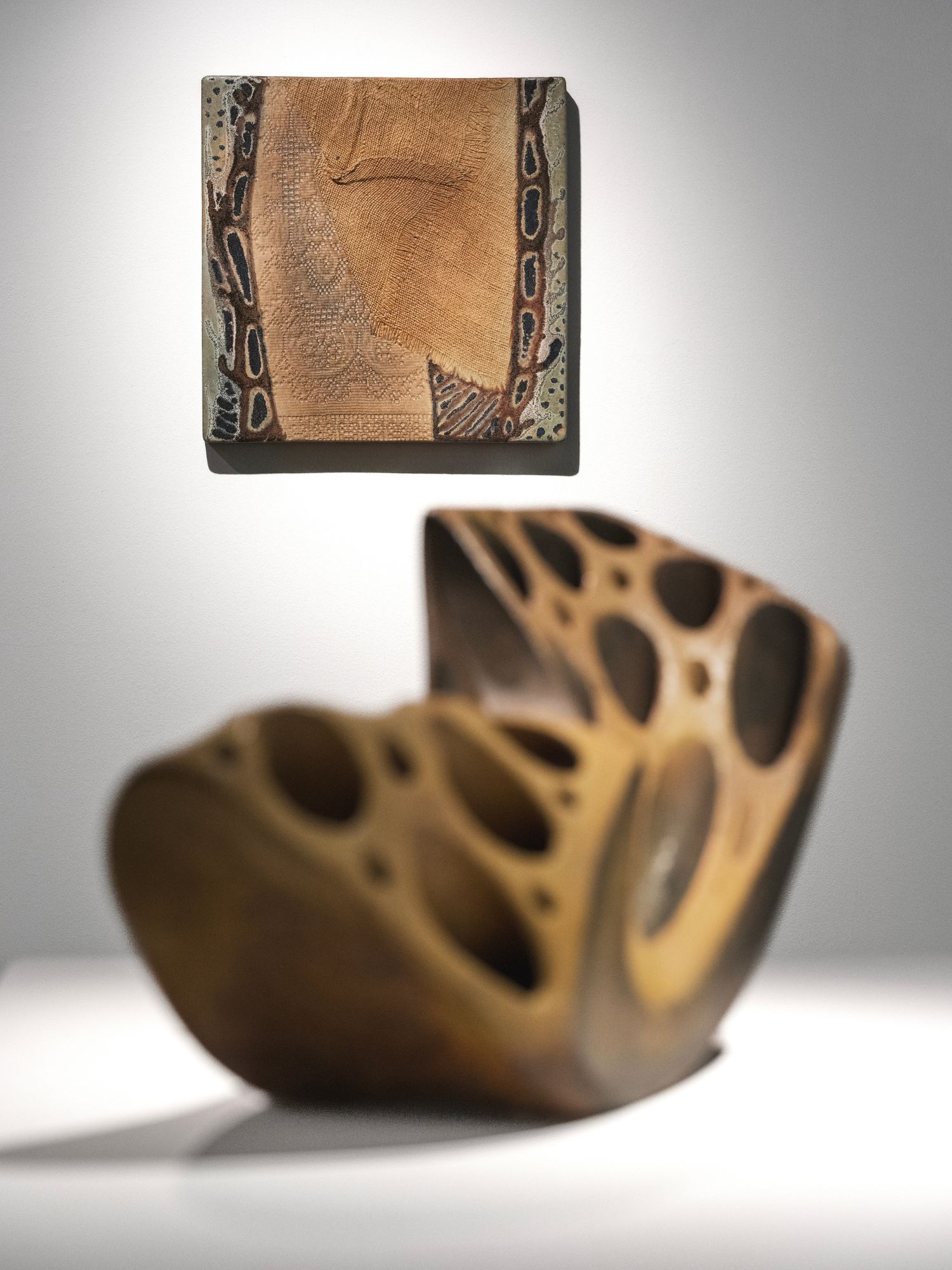
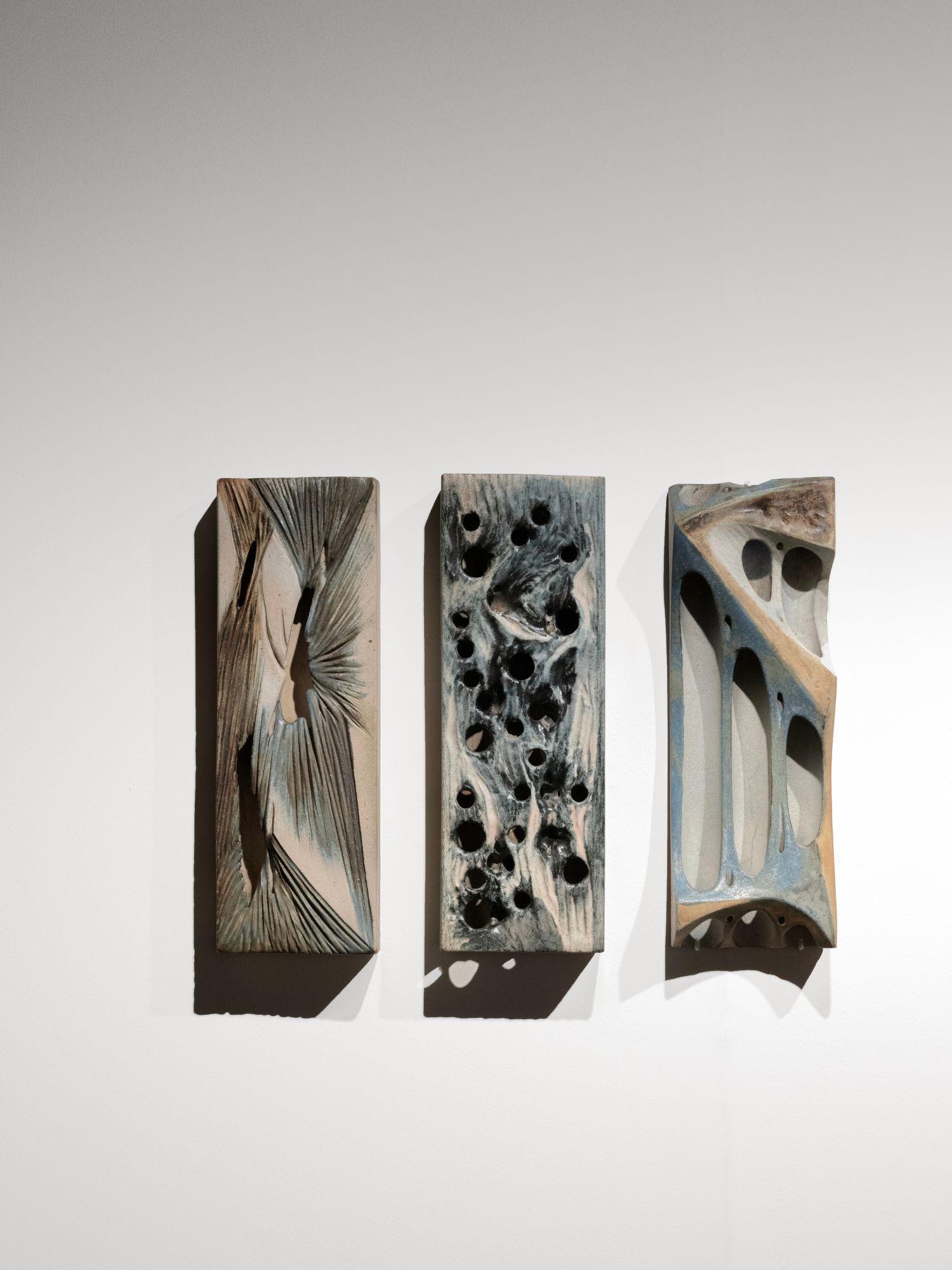
From as early as the 1950s, his work came into alignment with the debates on the integration of the arts that engaged architects and theorists of modernity. In this context, his connections with figures such as Alberto Sartoris are particularly significant. Sartoris’s thinking—advocating an architecture understood as a synthesis of the arts and grounded in formal clarity, constructive rigor, and three-dimensionality—provided the theoretical framework from which Cumella’s ceramics could be read as a form of latent architecture. In this way, his pieces, and especially his murals of the 1960s, can be interpreted not as ornamental claddings, but as visual and material structures that engage in dialogue with space. Indeed, one might also say that this same approach was shared by the architects of Grup R, as promoters of the renewal of postwar Catalan architecture, recovering the spirit of GATCPAC and reconnecting with European modernity. Cumella’s relationship with many of them—such as Josep Antoni Coderch, Oriol Bohigas, and Josep Maria Sostres—reveals a convergence of interests: attention to material, the importance of volume, and the desire to construct an architecture that, while austere, was expressive. In these projects, Cumella’s ceramics did not function as an added element, but as a constitutive part of the architectural work, capable of reinforcing its character and introducing a sensory dimension based on texture, light, and color.
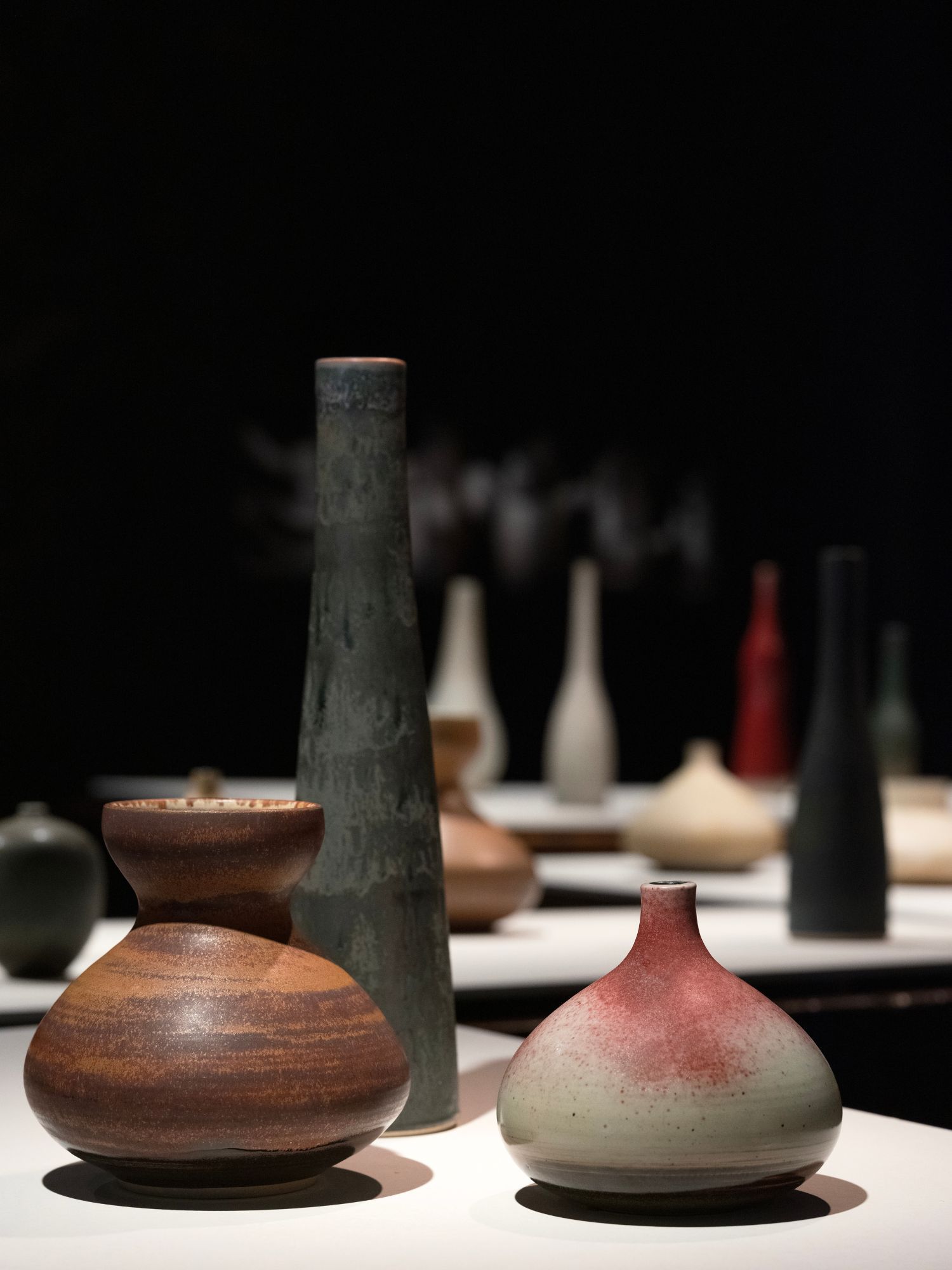
A key moment in the evolution of Cumella’s language took place in the late 1950s and, above all, during the 1960s. While in the earlier decades the artist had moved from sculpture to wheel-thrown work, producing glazed stoneware related to Eastern tradition and to the contribution of Llorens Artigas, by the end of the 1950s—after his first major recognitions—Cumella also began working on flat surfaces.
The exhibition at the Galería Illescas in Madrid in 1961 could be said to have marked the consolidation of this new phase, in which Cumella began to focus a very significant part of his production on murals and flat panels conceived for the wall. This shift should not be understood as a renunciation of volume, but rather as its reformulation: relief, surface modulation, and the use of matte and glossy glazes activate the mural plane and transform it into a dynamic space, responsive to light and to the viewer’s point of view.
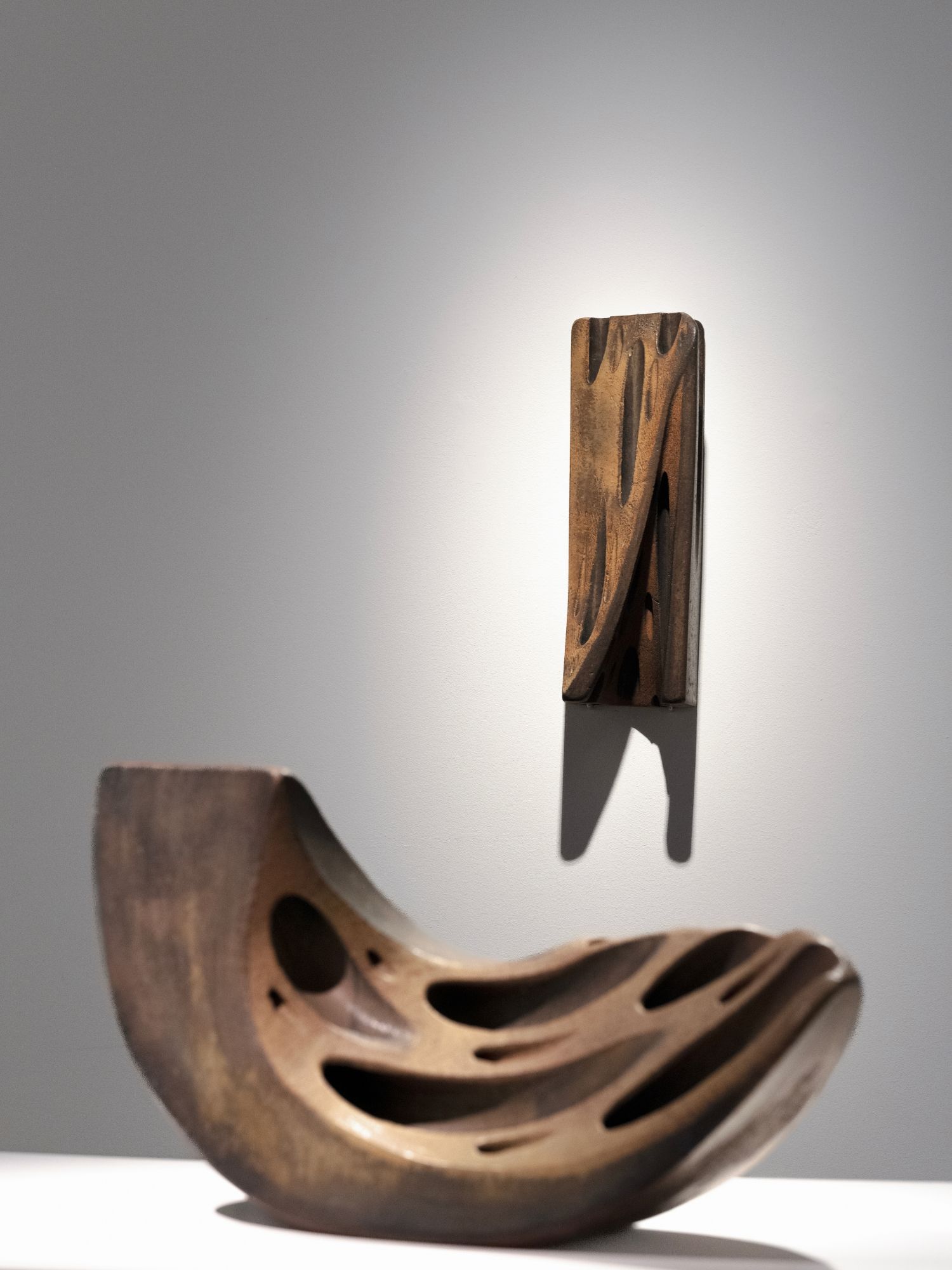
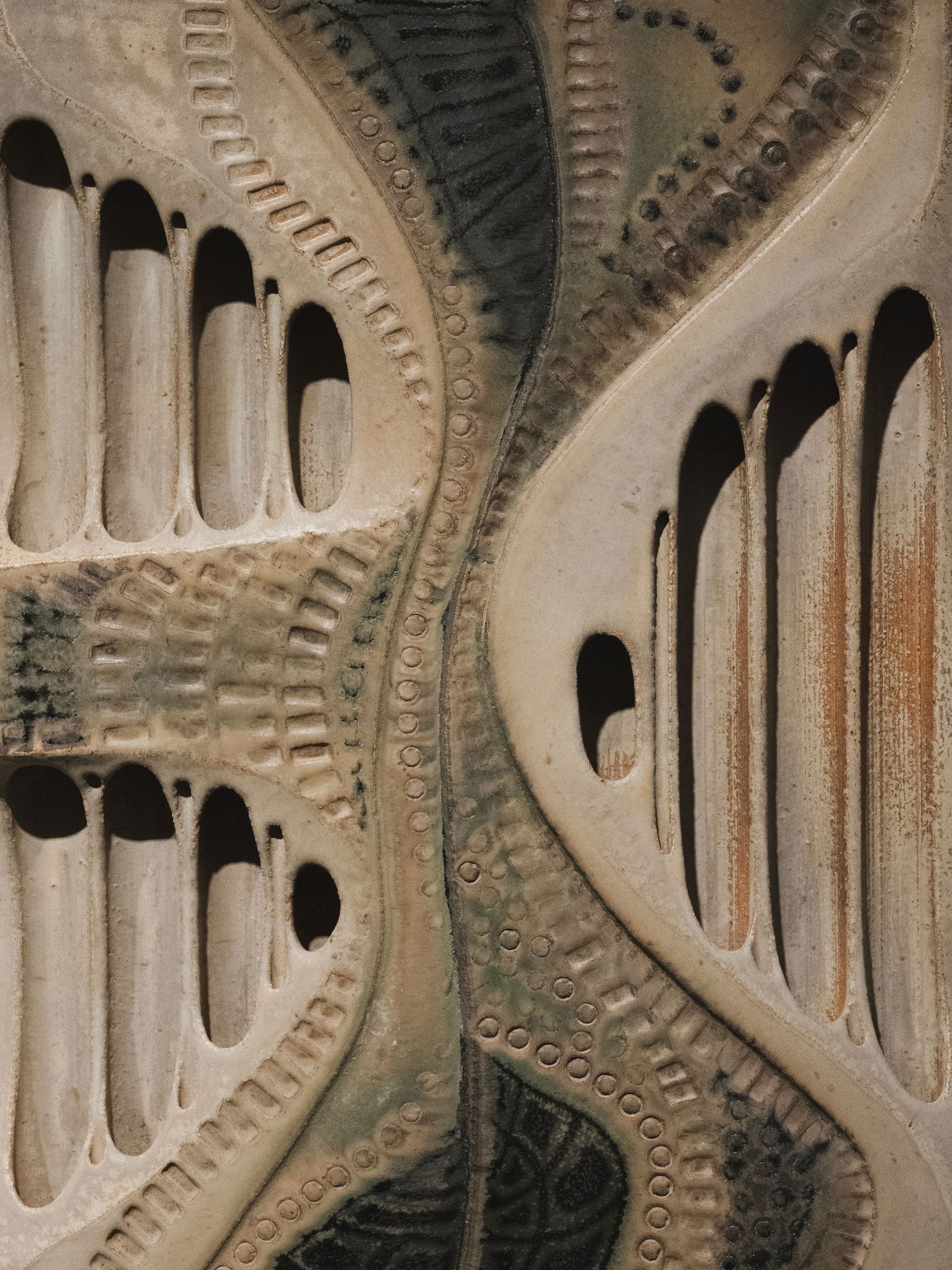
Following the creation of the mural for Casa Jansen (1958) by Fargas i Tous, and that of the Faculty of Law of Barcelona (1959), as well as the positive reception of the mural Hommage to Gaudí, created for the Spanish Pavilion that architect Javier Carvajal designed for the 1964 New York World’s Fair, Cumella began to receive commissions for large-scale mural projects applied to architecture, both in Spain and abroad, especially in Germany. A good example is the mural for the Sandoz building (1971), constructed on Gran Via in Barcelona by Xavier Busquets and Martin Burckhardt. Through these works, Cumella fully developed a distinctly sculptural form of ceramics, conceived for the scale of the building and for a direct relationship with the user. In each case, ceramics thus became a singular, active skin, capable of conveying material density and visual depth without disrupting the coherence of each architectural project. From this perspective, alongside the excellence he achieved in wheel-thrown work, one of Antoni Cumella’s most significant contributions lies in having placed ceramics at the center of modern architectural discourse and in having fully demonstrated how this material—rooted in an ancestral tradition—could assume a thoroughly contemporary role. His work applied to architecture not only expands the boundaries of ceramics, but also makes a decisive contribution to humanizing modern architecture, endowing it with a poetic, sensory, and enduring dimension.